Polarizing Microscope
Identification of rocks or minerals cam be challenging when studied as hand specimen. Additional parameters other than their physical properties are required. For this reason we need to study the optical properties of minerals as well.
The fundamental principle of optical microscropy is that most minerals or rocks, even the ones which appear opaque in hand specimen, transmit light if they are sliced thin enough. For these minerals the study of their optical properties is conducted by transmited light microscopy. Polarizing microscope or petrographic microscope is used for this purpose. In practice these specially prepared thin sections are around 30 micro meters thin.
On the other hand, some minerals do not allow transmission of light even when their thin sections are prepared. For these opaque minerals, their optical properties are studied by a technique known as reflected light microscopy
Construction
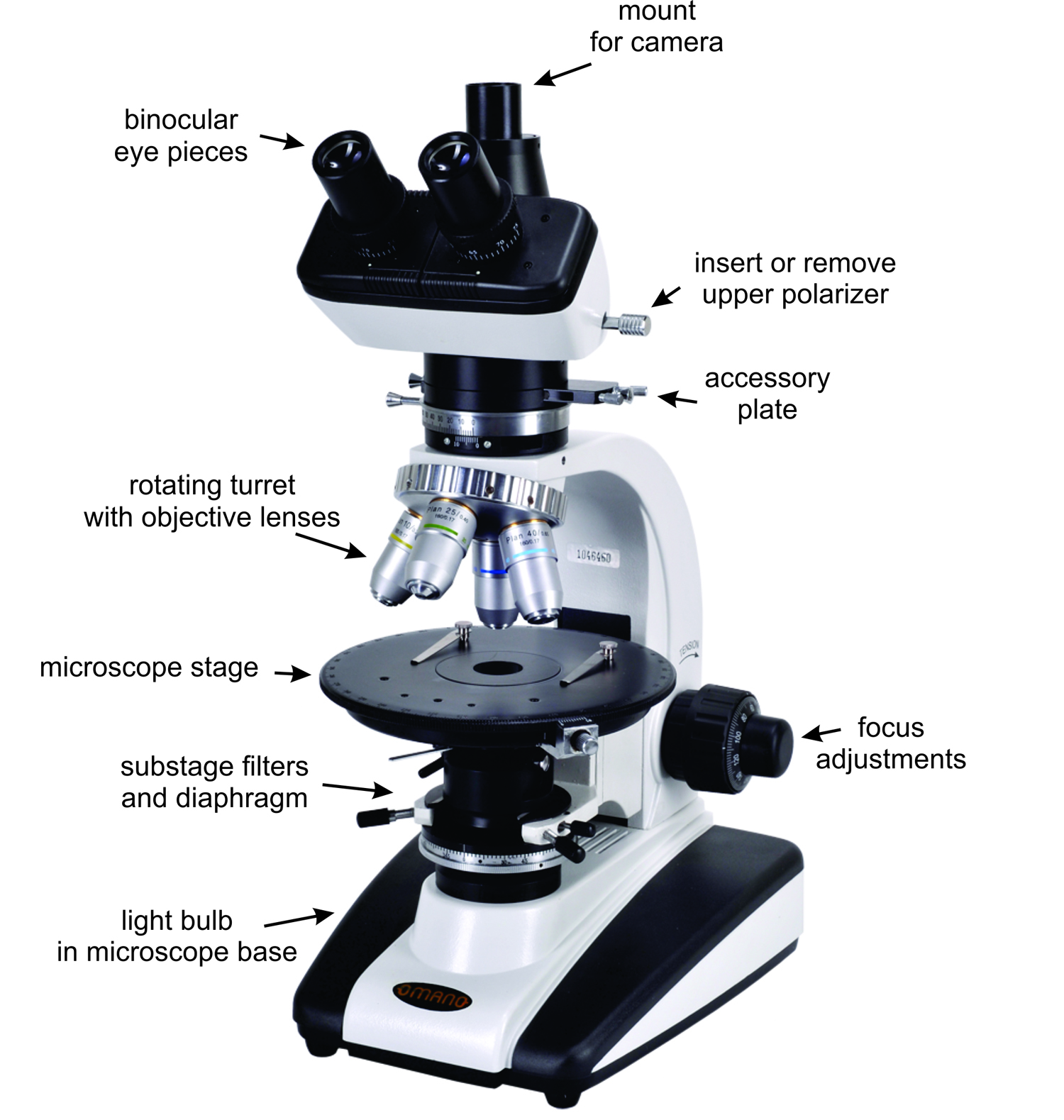
Illuminator
The illuminator is a steady source of light used for illumination of thin sections. It is used when performing transmitted light microscopy.
Rheostat
Rheostat is usually located at the base of the microscope. It is used to control the intensity of light from the illuminator.
Lower Polarizer
Lower polarizer is one of the most important filters of petrographic microscopes. It makes sure that all the light passing through it is plane polarized (vibrating in a fixed direction). It polarizes the light in east-west direction however older microscopes have lower polarizers oriented in north-south direction.
Iris Diaphragm
A diaphragm cuts down the amount of light that reaches the thin section sample by restricting the area that light can pass through. Overall it helps in focusing light on the mineral sample.
Condensing Lens
A fixed condensing lens in the substage helps concerntrate light on the sample.
Condenser
Condenser is a special lens, also called conoscopic lens, which can be inserted between lower polarizer and stage to produce conoscopic illumination. The condenser converges the light rays at one small spot on the sample and illuminates the sample with a cone of non parallel light rays.